OEE still runs on clipboards
Overall Equipment Effectiveness (OEE) is the standard approach to assess the effectiveness of today’s shopfloors around the world. As a key performance indicator for assessing and improving machine productivity, it comprises three separate elements – equipment availability, speed performance and quality, and is based on the assumption of data availability for any production losses on machines and processes.
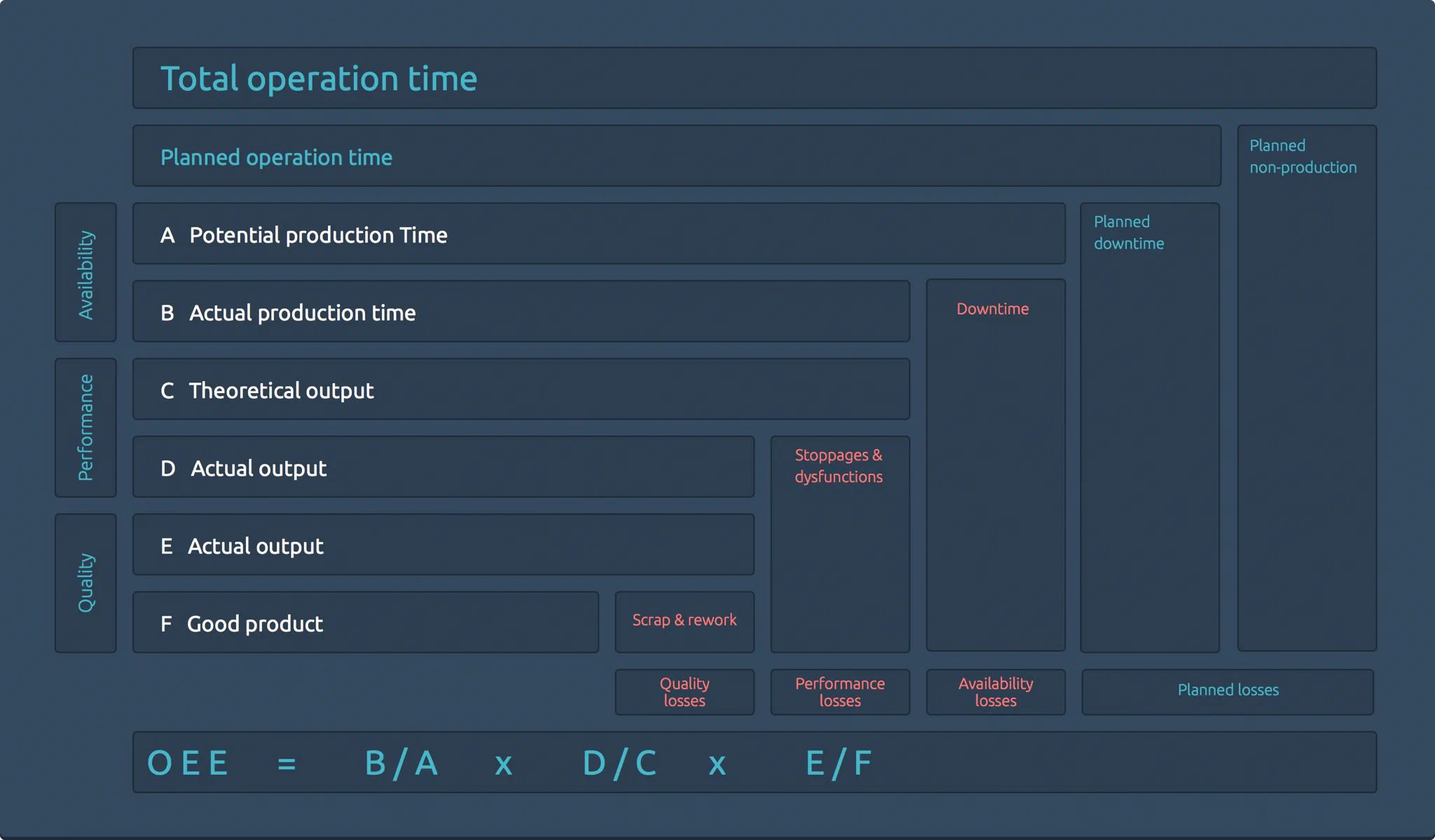
Having established OEE most production floors still collect their data manually, using clipboards watching the shopfloor and pasting them into spreadsheets for aggregation and calculation purposes. Connectivity to machines is still rare, and once the data is collected and gathered, the information becomes more or less outdated. Improvements have been made by automating the data acquisition process by retrieving the OEE-relevant data out of Manufacturing Execution Systems (MES). Nevertheless, the majority of the data still generated in shopfloor environments is never put to plausible use and left untouched.
Where relational databases stop, big data starts
Imagine the coexistence of sensory data and machine controller data sending endless streams of data – 24/7 – no established MES can handle these data volumes, not to mention storing, crunching or analyzing the data streams. The underlying relational database technologies are just not able to do that. As a result, the data is left untouched, although containing the most relevant information for process improvement and competitive advantage. Big Data is the key technology to make these data streams accessible and make them actionable and, with shopfloor processes being in constant need of improvement, manufacturing and big data technologies are a perfect fit. Being characterized by the 4 V’s (volume, velocity, variety, veracity) big data initiatives are often focusing production data collection, neglecting the 5th V of Big Data – to create value by establishing methods for big data processing, analyzing and utilization. DATATRONiQ connects production data streams through plug-and-play adapters and maps them onto predefined KPIs — no custom ETL per machine. Data driven algorithms create accelerated insights and actionable decisions in real-time (e.g. alerts triggered by anomalies in machine behavior) by delivering the right data to the right person, at the right time. Even antiquated production machines can be part of the DATATRONiQ data universe – e.g. a retrofit with our vibration sensors can be easily achieved.
OEE, redefined on live data
OEE is the well-established KPI for measuring and improving machine productivity. The classic way of OEE calculation is more or less insufficient, having in mind that the quality and up-to-date features of OEE itself can be improved significantly by:
- unlocking additional data sources (e.g. vibration data indicating machine failures)
- up-to-date features for more accurate decisions and real-time performance measurement
- predictive analytics (foresight instead of hindsight)
Each OEE component - this means respectively equipment availability, speed performance and quality control - is now fed with real-time information, an invaluable input to calculate a re-defined OEE. Furthermore, DATATRONiQ provides actionable understandings, enabling manufacturers to identify and focus on critical challenges in quality and operations.
Availability
DATATRONiQ signals events that stop planned production for a significant length of time, e.g. equipment failures, material shortages, and changeover time. Different stages of advanced analytics are applied in real-time, ranging from anomaly detection, root-cause-detection, and risk-calculations up to predictions of incidence time.
Performance
DATATRONiQ identifies any factor that causes the process to operate at less than the maximum possible speed – and does it all in real-time. Examples include machine wear, imperfect materials, misfeeds, and operator inefficiency.
Quality
DATATRONiQ correlates machine condition, imperfect materials and other influences to calculate a workpiece risk index for identifying produced pieces that do not meet quality standards, including pieces that require rework.
Start small, measure first
Many plants still lack the tooling to turn sensor and controller data into usable KPIs. With DATATRONiQ, operations teams start with a single line, score it continuously on availability, performance, and quality, and extend the pattern across the shopfloor once the numbers hold up — think big, start small.